

Japanese and Thai line breaking
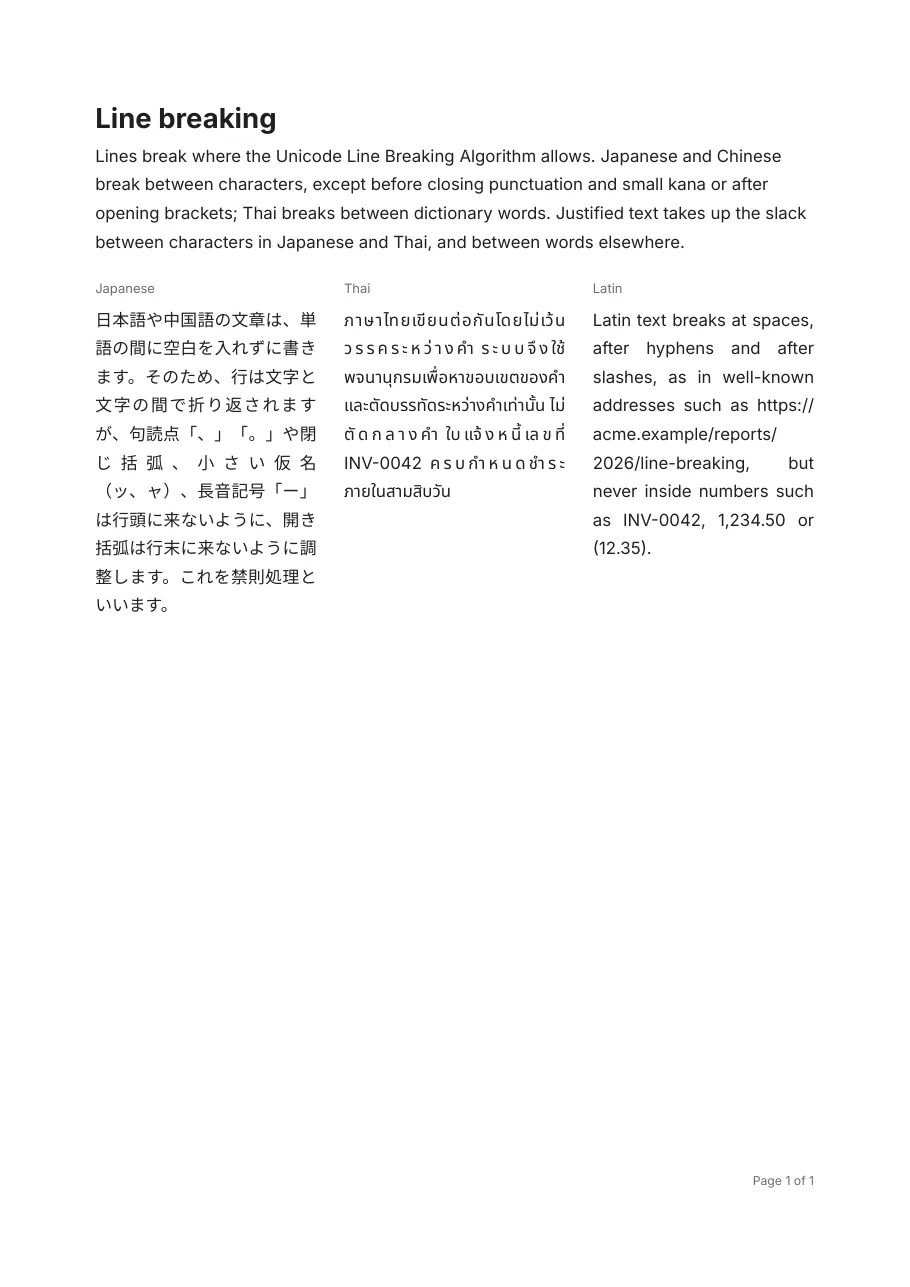
Three narrow justified columns: Japanese breaks between characters but keeps punctuation and small kana off the start of a line; Thai, written without spaces, breaks between words found in a dictionary; English breaks at spaces, hyphens and slashes. This is the Unicode Line Breaking Algorithm.
Standards: PDF/A-2b · PDF/UA-1, checked with veraPDF on every change. Download the PDF.
What it shows
Section titled “What it shows”- Japanese line breaking rules (kinsoku)
- Thai word breaking with a dictionary
- Justification between characters for Japanese and Thai
- PDF/A-2b and PDF/UA-1
The template
Section titled “The template”# yaml-language-server: $schema=../schema/template.schema.json# Line breaking by the Unicode Line Breaking Algorithm (UAX #14): Japanese breaks between characters but# keeps punctuation, small kana and closing brackets off the start of a line (kinsoku); Thai, written# without spaces, breaks between words found with a dictionary; Latin breaks at spaces, after hyphens and# after slashes. Three narrow, justified columns make every paragraph wrap: Japanese and Thai are# justified between characters, Latin between words. PDF/A-2b and PDF/UA-1.version: 1title: Line breakingculture: en-GB
document: author: Acme Ltd compliance: [pdf-a-2b, pdf-ua-1]
page: size: A4 margins: 22mm
fonts: Inter: regular: fonts/Inter-Regular.ttf bold: fonts/Inter-Bold.ttf fallback: [NotoThai, NotoJP] NotoThai: { regular: fonts/NotoSansThai-Regular.ttf } NotoJP: { regular: fonts/NotoSansJP-Regular-Subset.otf } # only the characters these samples use
styles: default: { font: Inter, fontSize: 11pt, lineHeight: 1.7, color: "#1F1F1F" } label: { fontSize: 8.5pt, color: "#6B6B6B", padding: 0 0 4pt 0 } column: { padding: 0 0 0 0 }
data: texts: fields: { Japanese: string, Thai: string, Latin: string }
body: dataset: texts
detail: - padding: 0 0 14pt 0 content: - { type: text, value: "Line breaking", fontSize: 18pt, fontWeight: bold, tag: h1 } - type: text value: >- Lines break where the Unicode Line Breaking Algorithm allows. Japanese and Chinese break between characters, except before closing punctuation and small kana or after opening brackets; Thai breaks between dictionary words. Justified text takes up the slack between characters in Japanese and Thai, and between words elsewhere.
- layout: row gap: 18pt content: - type: stack content: - { type: text, value: "Japanese", style: label } - { type: text, value: "{Japanese}", language: ja, align: justify } - type: stack content: - { type: text, value: "Thai", style: label } - { type: text, value: "{Thai}", language: th, align: justify } - type: stack content: - { type: text, value: "Latin", style: label } - { type: text, value: "{Latin}", align: justify }
pageFooter: - content: - { type: text, value: "Page {PageNumber} of {TotalPages}", align: right, color: "#6B6B6B", fontSize: 8pt }Render it yourself
Section titled “Render it yourself”Save the template, put the fonts it names next to it (Inter and the Noto fonts are free, under the SIL Open Font License), and run:
tagua render line-breaking.report.yaml --openWithout a data file, tagua render makes up sample rows from the field types; see Preview as you edit.